

How to Split Costs for Group Holidays: A Fair Guide
25 August 2026
Table of Contents
- Why Splitting Costs Fairly Matters for Group Holidays
- Fair Ways to Split Accommodation Costs
- Best Apps for Splitting Holiday Costs
- Using a Group Holiday Expense Spreadsheet Template
- Managing Food and Shared Expenses
- Setting Clear Agreements Before Your Holiday
- Common Mistakes to Avoid When Splitting Costs
- Conclusion
Last Updated: August 25, 2026
Why Splitting Costs Fairly Matters for Group Holidays
Organising a group holiday brings people together, but it also brings a practical headache: how do you split costs fairly so no one feels short-changed? When cost-splitting goes wrong, it poisons relationships. Friends stop talking. Family gatherings become awkward. What should be a shared memory becomes a source of resentment.
The real problem isn't mathematical difficulty, it's that most groups avoid the conversation altogether, hoping it will sort itself out. It won't. By the time the holiday ends, someone will have paid more than they should have, and the whole experience gets tainted.
How to split costs for group holidays comes down to three things: choosing a fair method upfront, tracking expenses transparently, and communicating clearly before anyone books. This guide covers practical approaches that work, from simple equal splits to methods based on nights attended or room choices. You'll also find templates and apps that handle the maths for you.
When you're planning a group getaway to somewhere like Bolberry, Nr Salcombe, South Devon, TQ7 3DY, where you might rent a property like Spring Barn at Bolberry Court that accommodates up to 10 people, getting the cost-splitting right from day one makes everything smoother.
Fair Ways to Split Accommodation Costs
Accommodation is usually the biggest expense in a group holiday, and it's where most cost disputes start. The method you choose depends on your group's circumstances and what feels genuinely fair to everyone involved.
Equal split across all guests
The simplest approach: add up the total accommodation cost and divide it equally among everyone attending. If the property costs £2,000 for a week and eight people are coming, each person pays £250 (peer-reviewed research).
This works brilliantly when everyone's staying the full duration and using equal space. It's transparent, easy to calculate, and no one can argue about the maths. Most groups default to this method because it's straightforward.
The catch appears when circumstances differ. If one person arrives two days late or leaves early, they shouldn't pay the same as someone there for the full week. For a property like Spring Barn at Bolberry Court, which sleeps up to 10 people, an equal split works especially well if your group size is stable and everyone's committed to the same dates.
Split by room or sleeping arrangement
Some groups prefer splitting by the bedroom each person occupies. If Spring Barn at Bolberry Court has four bedrooms and the accommodation costs £2,000, you'd divide the cost by four and charge each bedroom occupant accordingly.
A single occupant in one bedroom pays one share. A couple sharing a bedroom pays one share between them. This method acknowledges that people using more space should contribute proportionally.
The drawback: it assumes all bedrooms are equal, which they rarely are. You'll need to discuss and agree on any adjustments before booking.
Split by number of nights attended
This is the fairest method when people attend for different lengths of time. Calculate the cost per night (total accommodation divided by the number of nights), then multiply by how many nights each person is staying.
If the property costs £2,000 for seven nights, that's £285.71 per night (peer-reviewed research). Someone staying all seven nights pays £2,000. Someone arriving on day three and leaving on day six pays for four nights: £1,142.86.
This removes the "why should I subsidise someone who's only here for the weekend?" complaint. It's mathematically clean and feels genuinely fair. You need clarity upfront and a willingness to do slightly more arithmetic. A spreadsheet makes this manageable.
Best Apps for Splitting Holiday Costs
Once you've chosen your method, technology can handle the tracking and calculations. Several apps are designed specifically for splitting shared expenses among groups.
Digital expense trackers and their benefits
Apps that track shared expenses work by logging each purchase, assigning it to a category, and calculating who owes whom at the end. You photograph receipts, enter the amount and who paid, and the app automatically calculates settlements.
The main benefit is transparency. Everyone can see in real time what's been spent, on what, and by whom. This removes suspicion and makes the final reconciliation straightforward. These apps also handle the maths of complex settlements. If person A paid for accommodation, person B paid for food, and person C paid for activities, the app works out the net transfers needed to balance everything fairly.
A secondary benefit is documentation. If anyone disputes a charge later, you have a timestamped record with photos of receipts.
What to look for in a cost-splitting app
Choose an app that lets you:
- Create a group and add members by name or email
- Log expenses with a photo of the receipt
- Assign expenses to specific people or split them across the group
- Categorise expenses (accommodation, food, transport, activities)
- View real-time balances showing who owes whom
- Generate a final settlement summary
Avoid apps that require everyone to have a smartphone or a specific operating system. The best tools work on web browsers too, so anyone can access them from any device. Also check whether the app charges a fee. Many are free for basic use. For a one-off holiday, a free app is obviously preferable.
Using a Group Holiday Expense Spreadsheet Template
If you prefer not to use an app, a spreadsheet is just as effective and gives you complete control over the format and calculations.
Setting up your spreadsheet for clarity
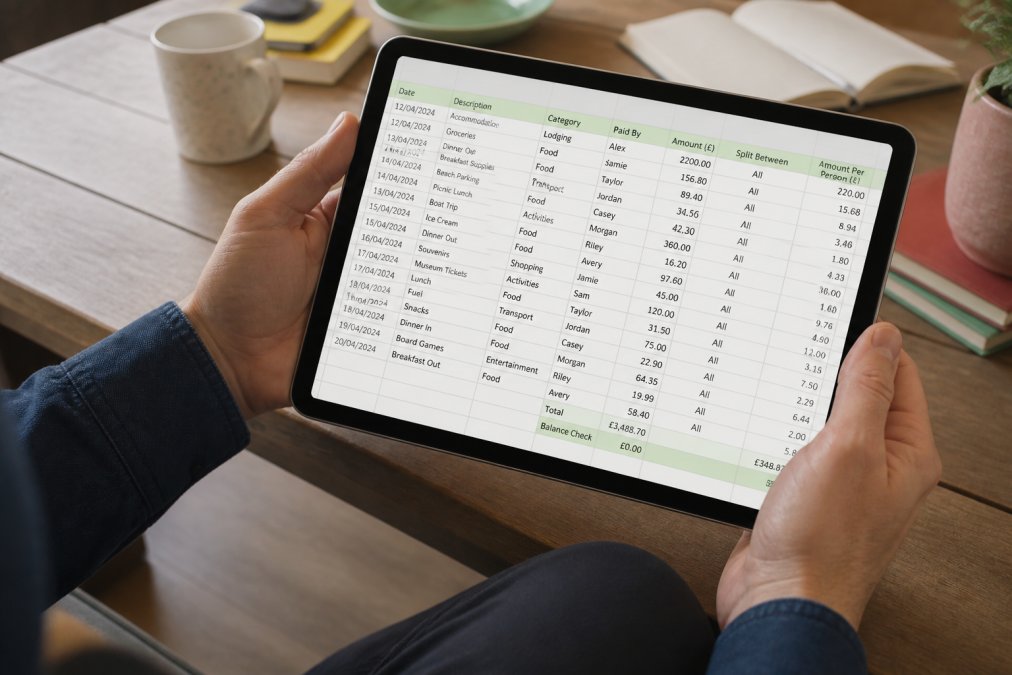
Start with columns for: Date, Description, Category, Amount, Paid By, and Split Among. Each row is one expense.
Below the main expense log, create a summary table showing each person's name, total amount paid, total amount owed (their share of all expenses), and the net balance. If the number is positive, they're owed money. If negative, they owe money.
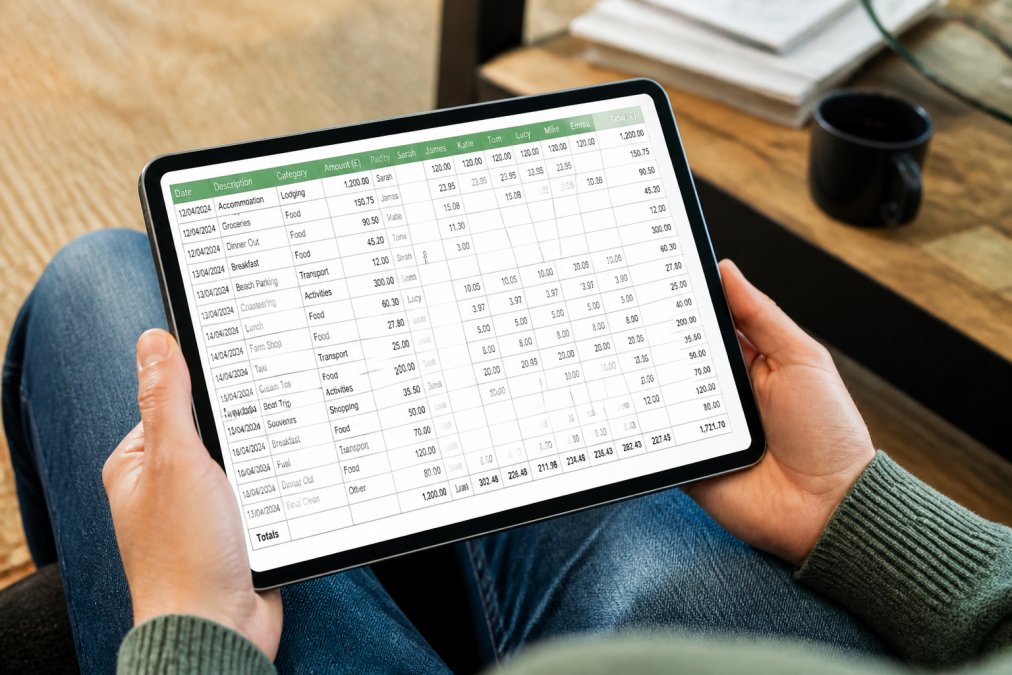
The formulas do the heavy lifting. Use SUMIF to total expenses paid by each person and total expenses they're responsible for. Subtract one from the other to get the net balance.
Make the spreadsheet shared so everyone can add expenses as they happen. Use different colours for different people or categories to make it scannable.
Tracking shared expenses in real time
Update the spreadsheet daily or every few days so no one forgets who paid for what. Assign someone to be the spreadsheet keeper. This person's job is simply to log expenses as receipts appear.
Make it a group habit to photograph receipts and share them with the keeper immediately. If someone makes a big purchase, log it immediately so the spreadsheet reflects reality.
Managing Food and Shared Expenses
Food costs can rival accommodation in a large group, and they're more complicated because not everyone eats the same things or eats together.
A common mistake is trying to split every meal equally. A better approach: designate certain meals as "group meals" that everyone contributes to equally, and let people handle their own snacks and separate meals. Or, use the spreadsheet to track who bought what and split only the shared items (group dinners, communal snacks) while everyone pays for their own breakfast and lunch.
For activities and entertainment, the same principle applies. If everyone's going on a boat trip, split the cost equally. If only some people are going, only they pay.
The key is deciding upfront which expenses are truly shared and which are individual choices. This conversation might feel awkward, but it's infinitely less awkward than discovering on the last night that someone's been subsidising others' spending.
Setting Clear Agreements Before Your Holiday
This is where most groups go wrong. They assume everyone has the same understanding of how costs will be split, then discover mid-holiday that they don't.
Discussing payment methods upfront
Before anyone books or pays for anything, have an explicit conversation about:
- Which accommodation costs are shared
- Which other costs are shared (food, activities, transport) and which are individual
- How you'll split accommodation (equal, by room, by nights attended)
- Who will pay the accommodation bill upfront and when others will reimburse
- Whether you'll use an app, spreadsheet, or informal tracking
- When final settlements will happen
Write these agreements down in an email or shared document that everyone acknowledges. This removes ambiguity and gives you something to refer back to if someone later claims they thought costs would be split differently.
Discuss payment methods too. Will people settle up during the holiday or after? Will you use bank transfers, cash, or a payment app? If someone can't pay immediately, what's the timeline?
Handling late payments and disputes
Establish what happens if someone doesn't pay their share by an agreed date. A friendly reminder is usually enough. If a genuine dispute arises, refer back to your written agreement calmly.
For a large group holiday to somewhere like Bolberry, Nr Salcombe, South Devon, where you might rent a property like Spring Barn at Bolberry Court, having these agreements in writing prevents misunderstandings that could spoil the entire experience.
Common Mistakes to Avoid When Splitting Costs
Several patterns repeatedly damage group holidays. Knowing them helps you sidestep the damage.
Not discussing costs upfront. Groups assume everyone's on the same page, then discover they're not. Clarify everything before the holiday starts.
Letting one person pay for everything. If one person books accommodation and expects reimbursement, make sure everyone understands the timeline. Don't let it become a loan that festers for months.
Ignoring small expenses. Small expenses add up. Track them all, even the £5 coffee run, or you'll end up with an incomplete picture.
Splitting everything equally when circumstances differ. If people are staying different lengths of time or attending different activities, equal splits create genuine unfairness. Adjust your method to match your actual situation.
Assuming someone else will sort it out. Groups often avoid the money conversation because it feels awkward. Then no one's tracking expenses, and the whole thing becomes a mess. Someone needs to own the tracking and spreadsheet.
Not revisiting agreements if circumstances change. If someone's partner suddenly joins the trip or someone needs to leave early, revisit the cost split.
Splitting costs fairly for a group holiday requires three things: a clear method chosen upfront, transparent tracking throughout, and honest communication about what's shared and what's individual. The method itself matters less than the agreement. An equal split, a per-night split, or a per-room split all work if everyone understands and accepts it before the holiday begins.
When you're booking a property like Spring Barn at Bolberry Court in Bolberry, Nr Salcombe, South Devon, TQ7 3DY, which accommodates up to 10 people, having these systems in place from day one means everyone arrives knowing exactly what they're paying. No surprises. No resentment. Just a group ready to enjoy their time together.
If you're planning a group holiday and want a property that's built for larger gatherings, contact Spring Barn at Bolberry Court to discuss your dates and group size. The team can help you understand what's included and what costs you'll need to split among your group.
Frequently Asked Questions
What is the fairest way to split holiday costs for a large group?
The fairest method depends on your group's circumstances. Equal splits work well when everyone attends for the same duration and uses similar amenities. If guests arrive on different dates or use separate rooms, splitting by room type or nights attended is more equitable. Discuss which method suits your group before booking. For a spacious property like Spring Barn that accommodates up to 10 people, you might split accommodation costs equally, then track shared expenses separately using an app or spreadsheet to ensure transparency and fairness throughout your stay.
Should we use an app to track group holiday expenses?
Apps designed for expense splitting offer real-time tracking, automatic calculations, and clear records that reduce disputes. They're particularly useful for groups larger than six people or when multiple shared expenses occur daily. However, simpler groups might prefer a shared spreadsheet. Choose based on your group's size, comfort with technology, and the complexity of expenses. Apps eliminate manual calculation errors and provide instant settlement summaries, making them ideal for larger gatherings where managing multiple transactions becomes challenging.
How do we handle deposits for large group bookings?
Designate one person as the booking organiser to handle the initial deposit with the property owner. Collect deposit contributions from all guests proportional to their share of the total cost, either equally or adjusted for room type. Use a spreadsheet or app to record who has paid and by when. Confirm the property's deposit terms and refund policy before collecting money from your group. This approach protects everyone by ensuring the booking is secured and preventing disputes over who paid what. Spring Barn's direct booking process makes this straightforward—contact them to discuss group deposit arrangements.
Is it better to split costs equally or by room type?
Equal splits are simplest and fairest when everyone receives similar benefits and stays the same number of nights. Splitting by room type works better when guests occupy different bedroom sizes or premium spaces. Consider your group's dynamics: equal splits strengthen group harmony and simplicity, whilst room-based splits acknowledge different comfort levels and may feel more equitable to some. Discuss preferences early and document your choice. For mixed-generation groups or families with varying needs, a hybrid approach—equal accommodation split plus individual tracking of personal expenses—often prevents resentment and keeps everyone satisfied.