

Tips for Planning Large Family Reunions: A Complete Guide
09 August 2026
Table of Contents
- Start Early: Set Your Timeline and Planning Committee
- How to Create a Family Reunion Budget That Works
- Choosing Large Group Accommodation for Family Reunions
- Send Invitations and Track RSVPs Effectively
- Family Reunion Activity Ideas for All Ages
- Plan Catering and Manage Dietary Requirements
- Use Your Family Reunion Checklist UK to Stay Organised
- Handle Accessibility, Inclusivity and Family Dynamics
Last Updated: August 9, 2026
Start Early: Set Your Timeline and Planning Committee
Planning large family reunions requires 6 to 12 months' lead time to allow guests to arrange travel and work schedules, and to secure accommodation without rushing.
A dedicated planning committee of 3-5 family members forms the foundation of success. Assign each person a specific area: accommodation and venue logistics, guest list and RSVPs, activities coordination, and catering with dietary requirements. This distributed approach prevents burnout and ensures multiple perspectives shape the event.
Choose committee members who are organised, communicative, and genuinely invested. Digital collaboration tools like shared spreadsheets make coordination simple across distances. Set a regular meeting schedule (monthly or fortnightly) to review progress and keep everyone aligned on deadlines.
Your first committee meeting should establish key milestones: when to announce the reunion, when to open accommodation bookings, when RSVPs are due, and when final numbers are needed for catering. Writing these dates down and sharing them with the entire family prevents confusion.
How to Create a Family Reunion Budget That Works
A realistic family reunion budget depends on the number of guests, location, length of stay, meals provided, and activities planned. Start by listing all major expense categories and estimating costs for each.
Accommodation is typically the largest expense. Self-catering properties like large houses or converted barns allow everyone to stay together comfortably and cost less than multiple hotel rooms. Self-catering also reduces meal costs and gives families flexibility to eat together at times that suit them.
Catering and groceries form the second major cost. Many reunions use a mix of home-cooked meals and group outings to restaurants or pubs. Some families ask everyone to contribute a dish, which spreads costs and adds variety.
Activities and entertainment come next. Some ideas are free or low-cost (games, walks, beach visits), whilst others have charges (guided tours, adventure activities). Set a budget based on what your family enjoys and what's available locally.
Other expenses include travel, reunion merchandise, and a 10-15% contingency buffer for unexpected costs.
Once you've estimated total costs, decide how to cover them. Some families split costs equally among all adults; others ask only those attending to contribute. Discuss this openly with your committee and communicate clearly with the wider family.

Choosing Large Group Accommodation for Family Reunions
Finding the right large group accommodation is one of the most critical decisions in planning large family reunions. You need a property that sleeps your entire family comfortably, has enough bathrooms, offers communal spaces where everyone can gather, and suits your budget and location preferences.
Start by deciding on your location. Do you want to stay near where your family originated, or choose a neutral destination that's reasonably accessible to most guests? Coastal areas, countryside retreats, and regions with good transport links are popular because they offer activities for all ages and feel like a genuine getaway.
Once you've chosen your location, search for self-catering properties marketed as suitable for large families or group bookings. Read reviews carefully, paying special attention to comments about space, comfort, cleanliness, and whether the property genuinely fits the number of guests it claims to accommodate.
What to Look for in a Reunion Venue
When evaluating accommodation, several factors determine whether it will work well for your group. The property should have enough bedrooms so privacy needs are respected. Check actual bed configurations, as a room that "sleeps four" might have two double beds or four single beds. Bathrooms matter enormously; ideally you want at least one bathroom per 2-3 people so mornings and evenings aren't chaotic.
Communal spaces are essential. You need a large kitchen where multiple people can cook together, a spacious dining area where everyone can eat at the same table, and a comfortable living room where the family can relax together in the evenings. These shared spaces create the atmosphere that makes a reunion feel special.
Safety and accessibility should factor into your decision, especially if your family includes young children, elderly relatives, or anyone with mobility needs. Look for properties with secure gardens, good lighting, handrails where needed, and accessible bathrooms. Spring Barn at Bolberry Court offers a fully enclosed garden and modern facilities designed for families and larger groups, making it a practical choice for multi-generational gatherings in South Devon.
Consider what amenities the property includes. A well-equipped kitchen with modern appliances makes self-catering easier. A log burner or underfloor heating is valuable during cooler months. Outdoor space, whether a garden, patio, or nearby walking routes, gives families options for activities. If your family is driving, check whether there's adequate parking and, if you have electric vehicles, whether EV charging is available on-site.
Location matters beyond just the region. Is the property close to shops, restaurants, attractions, and beaches? Are there walking routes nearby? A property that's beautiful but isolated might feel limiting if your family wants flexibility to explore or grab supplies easily.
Send Invitations and Track RSVPs Effectively
Once you've secured your accommodation and locked in your dates, create a clear, detailed invitation that includes the dates, location, accommodation details, costs involved, what's included, and the RSVP deadline. Make the invitation feel personal; this is a family event, not a corporate function.
Decide whether you're inviting everyone in your extended family or a specific branch. Be clear about who's invited so there's no ambiguity or hurt feelings.
Send invitations 3-4 months before the reunion. Use a mix of methods: email, printed invitations for older relatives, and family messaging apps. Make it easy for people to RSVP with a clear deadline and multiple response options.
Create a simple spreadsheet to track RSVPs. Record who's coming, how many people are in their group, any dietary requirements or accessibility needs, and contact details. Follow up with people who haven't responded a month before the reunion. This information is crucial for finalising catering numbers and ensuring the right accommodation setup.
As RSVPs come in, you might discover more or fewer people want to attend than expected. Be flexible; you may need to find additional accommodation nearby or adjust your plans. Communicate changes to your committee and the family promptly.
Family Reunion Activity Ideas for All Ages
One of the biggest challenges in planning large family reunions is keeping everyone entertained across multiple age groups. The best reunions offer a mix of structured activities and free time, so families can choose what suits them.
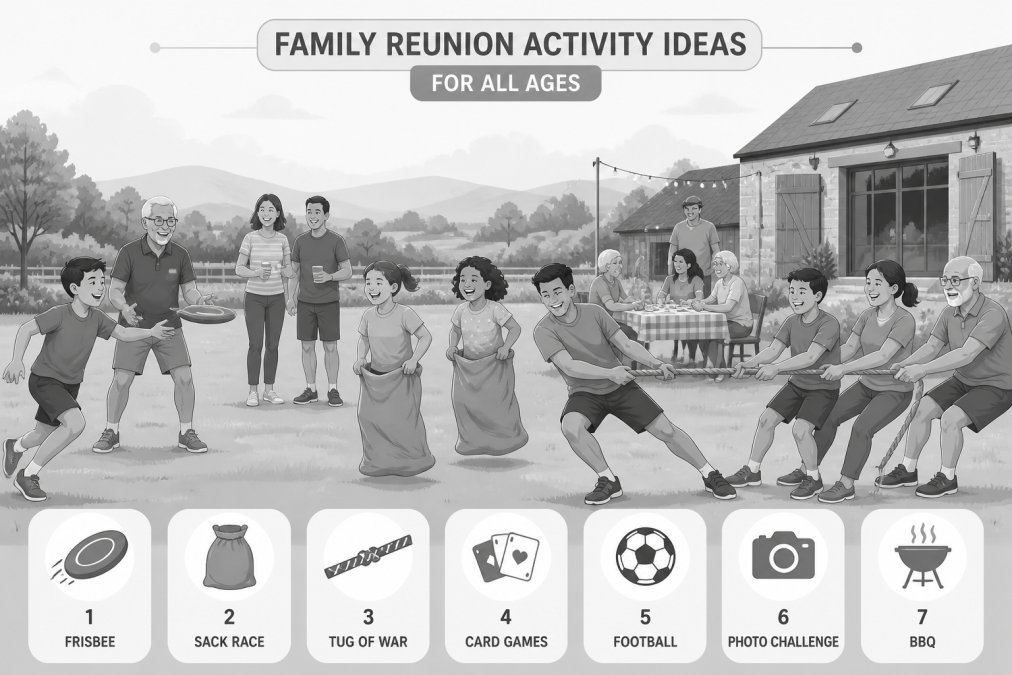
Outdoor activities work well for multi-generational groups. If your reunion is in a coastal location like South Devon, beach days are obvious: building sandcastles with young children, paddling, exploring rock pools, or walking along the shore. Walking and hiking appeal to active family members and can be scaled to different fitness levels. Organised group games, rounders, badminton, giant Jenga, relay races, get everyone involved and create memories.
Indoor activities matter too, especially if weather is poor. Board games, card games, and quiz nights encourage interaction across age groups. Craft activities work well for children and can engage adults, such as making family tree posters, creating reunion scrapbooks, or designing t-shirts with a reunion theme. Cooking together combines activity with practical purpose.
Consider activities that celebrate your family specifically. A family history session where older relatives share stories and photos creates connection and gives younger generations a sense of where they come from. A talent show or karaoke night, if your family enjoys that, often becomes a highlight.
Some activities work best if booked in advance: a guided coastal walk, a visit to a local attraction, or a group meal at a restaurant. Other activities can be spontaneous, such as a game session that develops naturally in the evening or an impromptu walk when the weather's nice.
The key is offering variety. Not everyone wants to be busy every moment; some family members will prefer quiet time reading, chatting in small groups, or exploring the local area independently. A good reunion schedule includes both structured activities and unstructured time.
Plan Catering and Manage Dietary Requirements
Feeding a large group is logistically complex but manageable with planning. Decide early whether you're doing full catering, partial catering, or self-catering where families sort their own food. Self-catering is most common for multi-day reunions because it's flexible and cost-effective.
If you're self-catering, designate someone to plan menus for shared meals. Coordinate with your committee about what you'll cook together and what people might source independently. Many reunions use a combination: some home-cooked meals prepared together, some takeaways or restaurant meals, and some meals where families fend for themselves.
Create a detailed list of dietary requirements early. Ask each family, when they RSVP, about allergies, intolerances, vegetarian or vegan preferences, religious dietary restrictions, and any other requirements. Assign someone to manage this list and communicate it to whoever's doing the cooking.
Shopping for a large group requires organisation. Make a master shopping list based on your menus, check what the accommodation kitchen already has, and decide whether to shop before arrival or split shopping duties among families. Ensure the self-catering kitchen has adequate storage, refrigerator space, and cooking equipment.
Plan at least one special meal, perhaps a formal dinner one evening or a celebration meal on the final night. This can be home-cooked or a group restaurant booking. Special meals create focal points and give the reunion a sense of occasion.
Stock tea, coffee, soft drinks, and juice. Have snacks available so people can help themselves between meals.
Use Your Family Reunion Checklist UK to Stay Organised
Keeping track of everything involved in planning large family reunions is easier with a comprehensive checklist. Working through a family reunion checklist UK systematically ensures you haven't overlooked important tasks.
| Task | Timeline | Owner | Status |
|---|---|---|---|
| Form planning committee | Months 12-11 | Lead organiser | |
| Choose location and dates | Months 11-10 | Committee | |
| Secure accommodation | Months 10-8 | Accommodation lead | |
| Create budget and cost-sharing plan | Months 10-9 | Finance lead | |
| Design and send invitations | Months 9-8 | Communications lead | |
| Set RSVP deadline | Months 8 | Communications lead | |
| Track RSVPs and dietary requirements | Months 8-4 | RSVP coordinator | |
| Finalise guest list and numbers | Months 4-3 | RSVP coordinator | |
| Plan activities and book in advance | Months 6-3 | Activities lead | |
| Plan menus and create shopping list | Months 3-2 | Catering lead | |
| Confirm final numbers with accommodation | Months 2-1 | Accommodation lead | |
| Send final details to all families | Weeks 4-2 | Communications lead | |
| Complete shopping and prep | Weeks 2-1 | Catering lead | |
| Welcome families and settle in | Week 1 | All |
A comprehensive family reunion checklist UK should cover all major areas: planning and committee, accommodation and logistics, invitations and RSVPs, activities and entertainment, catering and dietary requirements, and post-reunion follow-up. Print it out or keep it in a shared document your committee can access and update.
Handle Accessibility, Inclusivity and Family Dynamics
Large family gatherings can be joyful, but they also involve complex family dynamics. Planning for accessibility and inclusivity from the start prevents problems and ensures everyone feels welcome.
Accessibility means ensuring the reunion is physically accessible to family members with different abilities. When choosing accommodation, check for wheelchair access, accessible bathrooms, and ground-floor bedrooms if needed. Ask family members about their needs when they RSVP so you can plan accordingly.
Inclusivity means ensuring that family members from different backgrounds, cultures, religions, and family structures feel included. If your family is blended, divorced, or includes same-sex couples or single parents, make sure your communications and activities welcome everyone equally.
Family dynamics can be challenging. Some relatives might have had conflicts or not seen each other for years. Your role as organiser isn't to fix family relationships, but you can minimise tension by keeping activities structured, grouping people thoughtfully, having quieter spaces available for breaks, and keeping alcohol consumption moderate.
Some families find it helpful to establish simple ground rules: no discussion of politics or religion, no rehashing old grievances, everyone treats each other with respect. Communicate these gently in advance.
After the reunion, follow up with family members. Send thank-you messages, share photos, and ask for feedback about what worked well and what could be improved next time. This post-reunion follow-up keeps the sense of connection alive.
Planning large family reunions is complex, but breaking the work into manageable tasks and distributing responsibility across a committee makes it achievable. The key is starting early, communicating clearly, and focusing on what matters most: creating time and space for your family to connect. When choosing your accommodation in a location like Bolberry, Nr Salcombe, South Devon, TQ7 3DY, prioritise properties designed for large groups, like Spring Barn at Bolberry Court, that offer the space, comfort, and facilities your multi-generational family needs. With thoughtful planning and the right venue, your reunion will create memories that last for years.
Frequently Asked Questions
How far in advance should you plan a family reunion?
Start planning 6-12 months ahead for larger gatherings. This gives you time to secure accommodation, coordinate schedules, and manage logistics. For smaller, more informal reunions, 3-4 months is the minimum. The earlier you begin, the more options you'll have for venue selection and the better your event timeline will be. Early planning also allows family members to request time off work and arrange travel.
What should be included in a family reunion checklist UK?
Your family reunion checklist UK should cover: setting a budget, selecting accommodation, creating a guest list, sending save-the-date notices, managing RSVPs, planning activities, arranging catering, confirming dietary requirements, organising transport, assigning volunteer roles, arranging insurance if needed, and planning post-reunion follow-up. A comprehensive checklist ensures nothing is overlooked and helps your reunion committee stay coordinated throughout the planning process.
What are some low-cost activities for large family reunions?
Free or budget-friendly activity ideas include: outdoor games (rounders, badminton, walking trails), talent shows, quiz nights based on family history, craft activities, picnics, group photo sessions, and storytelling sessions. If your accommodation has outdoor space, like a fully enclosed garden, you can organise lawn games without extra expense. Local beaches and walking routes near coastal reunions are also free entertainment options that suit multi-generational groups.
How do you manage dietary requirements for a large family reunion?
Send a dietary survey with your invitations asking about allergies, vegetarian/vegan preferences, religious requirements, and other restrictions. Compile responses and share with your caterer or meal coordinator. Plan a mix of dishes to accommodate everyone, vegetarian options, allergen-free choices, and standard meals. If self-catering, ensure your accommodation has adequate kitchen facilities. For large groups, having a spreadsheet of dietary needs helps your catering logistics run smoothly and prevents last-minute surprises.