

Multi-Car EV Road Trip Planning in Devon
12 August 2026
Table of Contents
- Understanding Your Electric Vehicle Range and Battery Efficiency
- EV Road Trip Itinerary Planning for Group Travel
- How to Plan Charging Stops for Multiple EVs in a Convoy
- Best EV Charging Apps for UK Road Trips
- Finding Public Charging Infrastructure and Rapid Chargers
- Preparing Your Cars and Managing Range Anxiety
- Choosing Accommodation with Destination Charging
- Frequently Asked Questions
Last Updated: August 12, 2026
Understanding Your Electric Vehicle Range and Battery Efficiency
Electric vehicle range refers to the maximum distance your EV can travel on a single charge, determined by battery capacity, driving conditions, and energy consumption patterns. Understanding this is fundamental to planning a multi-car EV road trip in Devon, where terrain, weather, and route complexity all affect how far your vehicles will actually go.
Battery efficiency varies significantly based on real-world factors. Cold weather reduces range by 20-40%, whilst motorway driving at sustained speeds consumes more energy than mixed urban and rural routes. Devon's rolling South West terrain means elevation changes will impact your convoy's collective range, particularly if you're mixing different vehicle models with varying efficiency ratings.
The real issue isn't running out of charge entirely, it's managing top-up charging strategically so no vehicle in your convoy drops below 20% battery before reaching the next rapid charger. A vehicle that achieves 200 miles of range in mixed driving might only manage 160 miles on a continuous motorway run.
EV Road Trip Itinerary Planning for Group Travel
Planning an EV road trip itinerary for group travel requires coordination beyond what a single driver needs. When you're moving three or more vehicles, the slowest charger and the least efficient vehicle set the pace for your entire group.
Start by mapping your route using a routing tool designed for electric vehicles, not standard navigation apps. These platforms account for charging infrastructure, terrain, and real-world efficiency data. Enter your group's vehicle types, desired daily mileage, and charging preferences. The system will suggest logical stopping points where multiple rapid chargers exist, reducing the risk of arriving at a charging hub only to find all stations occupied.
Build flexibility into your itinerary. Don't aim to charge exactly once per 150 miles. Instead, identify two or three charging options at each stage, so if one location is congested, your convoy can pivot to an alternative without significant delay. This is particularly important during peak holiday periods when charging infrastructure becomes bottlenecked.
Consider timing your charging stops around meal breaks and rest periods. A 30-minute rapid charging session aligns naturally with lunch or a comfort break, turning what could feel like lost time into a structured part of your journey. For groups staying in Bolberry, Nr Salcombe, South Devon, timing your arrival around late afternoon gives you the opportunity to top up overnight using destination charging, meaning you start your next day with full batteries.
How to Plan Charging Stops for Multiple EVs in a Convoy
Planning charging stops for multiple EVs requires finding chargers with enough capacity and availability to handle three, four, or more vehicles arriving simultaneously.
Start by identifying rapid charging hubs along your route. A rapid charger delivers 50 kW or more, taking most modern EVs from 20% to 80% state of charge in 25-35 minutes. Ultra-rapid chargers (150+ kW) exist at major motorway service stations and can reach 80% in 15-20 minutes, but availability is limited and demand is high.
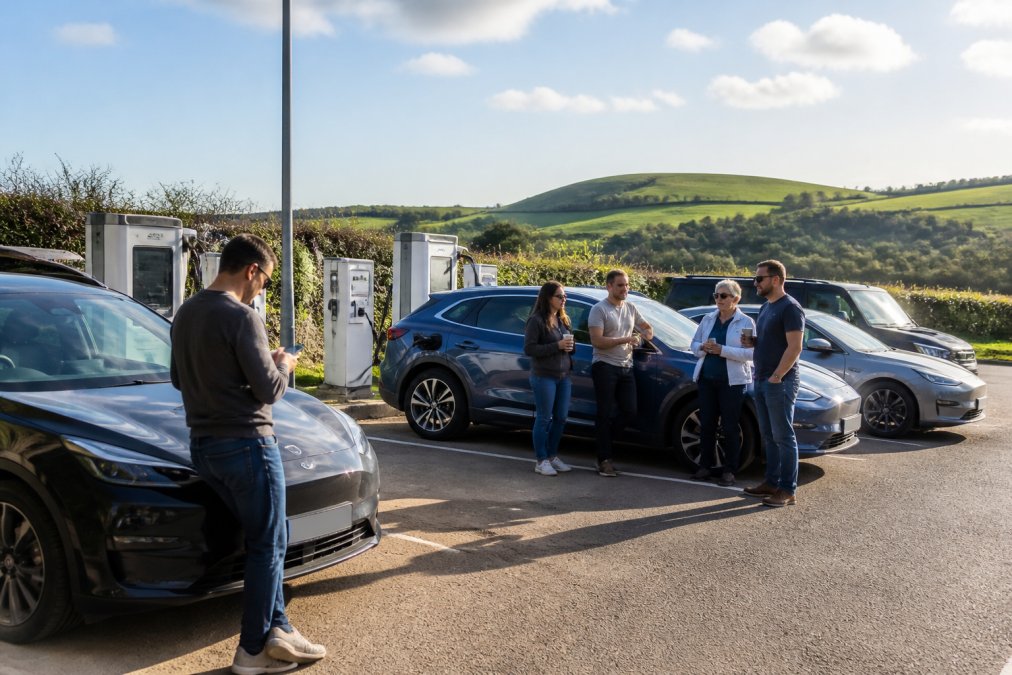
Check real-time availability before committing to a stop. Many charging networks offer mobile apps showing live occupancy data, preventing your convoy arriving expecting three available chargers only to find all occupied with lengthy queues.
Stagger your charging if necessary. If a hub has only two rapid chargers and your convoy has four vehicles, have two vehicles charge for 30 minutes whilst the other two grab refreshments and stretch their legs, then swap. This approach keeps everyone moving and prevents frustration.
Communication is essential. Use a group messaging app to confirm charging locations in advance, share real-time availability updates, and coordinate arrival times. If one vehicle has a lower battery percentage than others, prioritise its charging slot first. For multi-car EV road trip planning in Devon, remember that coastal charging infrastructure is less dense than motorway corridors. Plan your final approach to Bolberry, Nr Salcombe, South Devon with this in mind, charging fully at the last major hub before heading south.
Best EV Charging Apps for UK Road Trips
Selecting the right EV charging apps transforms your road trip from stressful to manageable. The best EV charging apps for UK road trips combine real-time availability, network coverage, and user-friendly interfaces that work reliably in areas with patchy mobile signal.
Zap-Map is the most widely used UK charging app, covering over 35,000 charging points across all major networks. The app shows real-time availability, connector types, and pricing. For multi-car EV road trip planning, the ability to see which chargers are currently in use is invaluable.
ChargePlace Scotland covers the entire UK network and integrates data from most major operators. It's particularly useful for finding free charging points at various retail locations and car parks. Pod Point's app integrates with their network of rapid chargers and provides subscription options for frequent users. InstaVolt focuses on ultra-rapid charging at strategic UK locations, offering some of the fastest charge times available.
For EV road trip planning in Devon specifically, download Zap-Map and at least one backup app. The South West has good coverage, but redundancy matters.
Finding Public Charging Infrastructure and Rapid Chargers
Public charging infrastructure across the UK has expanded significantly, but density varies by region. Finding rapid chargers and building them into your multi-car EV road trip itinerary requires understanding the network landscape.
Motorway service stations now feature rapid and ultra-rapid chargers as standard. These are your primary waypoints for long-distance convoy travel. Coastal areas, including Devon, have sparser infrastructure than motorway corridors. However, charging networks have prioritised popular tourist destinations. Towns near Bolberry, Nr Salcombe, South Devon, including Salcombe, Kingsbridge, and Dartmouth, have rapid chargers at retail parks and car parks.
Real-time availability is critical. For convoy travel, aim to arrive at charging hubs during off-peak periods (mid-morning or mid-afternoon) rather than lunch hours or late afternoon when other travellers are stopping. Connector types matter more than many drivers realise. The UK predominantly uses CCS (Combined Charging System) and Type 2 connectors for rapid charging. Before your journey, confirm that every vehicle in your convoy can use the chargers you're planning to stop at.
Preparing Your Cars and Managing Range Anxiety
Preparing your cars for a multi-car EV road trip in Devon means more than just ensuring they're charged. Range anxiety, the psychological concern about running out of charge, affects driver behaviour and decision-making throughout your journey.
Service your vehicles before departing. Check tyre pressure, which significantly impacts energy consumption. Under-inflated tyres can reduce range by 5-10%. Ensure battery conditioning systems are functioning properly, as these maintain optimal battery temperature during charging and discharge cycles.
Reduce unnecessary weight. Remove roof racks, roof boxes, and items from the boot. Every 100 kg of additional weight reduces range by approximately 5%. For a convoy journey, this adds up quickly across multiple vehicles.
Programme your vehicles with real-world efficiency data, not manufacturer estimates. Devon's terrain, rolling hills, winding coastal roads, and mixed urban/rural driving differs from standardised test conditions. Adjust your vehicle's efficiency estimates downward by 15-20% to create a safety margin.
Manage range anxiety by reframing how you think about charging. You're not trying to reach maximum range, you're trying to maintain consistent top-up charging throughout your journey. Stop at 60-70% battery rather than running to 20%.
Choosing Accommodation with Destination Charging
Destination charging transforms your accommodation from a place to sleep into a strategic advantage for your multi-car EV road trip in Devon. When your accommodation has on-site charging, you arrive with depleted batteries and leave with full ones, maximising your daily range and eliminating the need for morning charging stops.
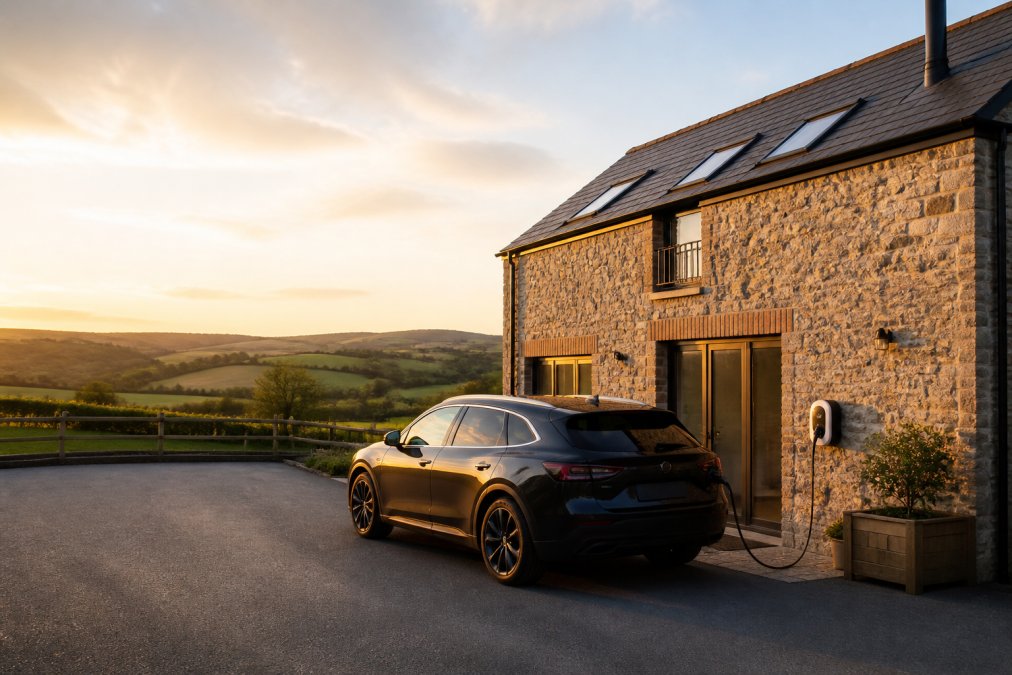
Most destination chargers operate at 7-22 kW, delivering a full charge overnight (8-12 hours depending on battery size). This is perfectly adequate for holiday accommodation where you're staying multiple nights. You don't need rapid charging at your accommodation, you need reliable, convenient charging that happens whilst you're sleeping or enjoying your stay.
Spring Barn at Bolberry Court offers on-site EV charging. For a multi-car EV road trip where your group includes three or more vehicles, this single feature eliminates significant logistical complexity. Every vehicle can charge overnight, meaning you start each day with full batteries and maximum range.
When evaluating accommodation options, ask specific questions about destination charging. How many charging points are available? What's the charging speed? Is charging included in your booking, or is there an additional fee? Can multiple vehicles charge simultaneously? These details matter when coordinating a convoy.
Accommodation near Bolberry, Nr Salcombe, South Devon also provides proximity to the South West Coast Path and local beaches, meaning you can maximise your daily range for activities rather than using it for repositioning between accommodation and charging points. For groups of up to 10 people planning an EV road trip, Spring Barn at Bolberry Court provides the space, amenities, and charging infrastructure that makes multi-car travel genuinely convenient.
Planning a multi-car EV road trip in Devon requires coordination, preparation, and strategic thinking that goes beyond single-vehicle travel. The infrastructure exists, the technology is reliable, and the South West offers genuinely rewarding driving experiences. What transforms a logistically complex journey into an enjoyable adventure is choosing accommodation that supports your vehicles as well as your group.
Spring Barn at Bolberry Court combines luxury self-catering space for groups with on-site EV charging, underfloor heating for year-round comfort, and direct access to the South West Coast Path. For environmentally conscious travellers planning an electric vehicle road trip, this is the accommodation that removes the friction from group travel. Contact Spring Barn at Bolberry Court to discuss your specific group's needs, or check availability and book directly for your preferred dates.
Frequently Asked Questions
How do I plan a multi-car EV road trip effectively?
Start by checking the state of charge and real-world range for each vehicle in your group, then map your route using dedicated EV apps that show rapid chargers and charging hubs. Stagger departure times if vehicles have different ranges, plan charging stops at intervals of 100-120 kilometres, and use a shared messaging group to coordinate arrival times and charging schedules. Book destination charging at your accommodation in advance—properties with on-site EV charging eliminate the stress of finding public chargers after a long drive.
What apps are best for syncing multiple electric vehicles on a journey?
The leading EV charging apps for UK road trips include PlugShare, Instavolts, and Zap-Map, which show real-time availability of rapid chargers and ultra-rapid charging points. These apps let you filter by connector type and charging speed, essential when coordinating multiple vehicles with different requirements. For group logistics, use WhatsApp or a shared calendar app to track each car's charging stop times and state of charge, ensuring no one is left waiting at a charging hub.
Are there enough rapid chargers for group travel in the South West?
The South West has a growing public charging network with rapid and ultra-rapid chargers at major service stations and dedicated charging hubs, though availability is less dense than the Midlands or South East. Plan routes that use established charging corridors along the M5 and A38, and always check real-time availability via apps before committing to a stop. Booking destination charging at your holiday accommodation ensures you have reliable overnight charging, reducing reliance on public infrastructure.
What should I pack for an electric vehicle road trip?
Bring your charging cables and adapters for each vehicle's connector type, a portable phone charger, snacks for charging stops, and printed or digital copies of your itinerary with charging locations marked. Check weather forecasts, as cold temperatures and rain reduce battery efficiency and vehicle range. Pack entertainment for waiting times at charging hubs, and ensure each driver has the EV charging apps downloaded before departure. If staying at accommodation with destination charging, confirm the cable type in advance to avoid surprises.