

How to Plan a Coastal Road Trip in an Electric Car
10 November 2026
Last Updated: November 8, 2026
Quick Summary
Plan a coastal road trip in an electric car by working from a realistic range, not the official figure: plan for roughly three-quarters of your car's quoted range and never arrive anywhere with less than a fifth of battery left. Use a route planner to map charging stops, check Zapmap for recent check-ins, and note a backup charger in the next town before committing to each leg.
- Short legs between scenic stops suit an EV better than a 200-mile motorway slog.
- Charge to 80% rather than 100% on rapid chargers, as the last fifth takes longest.
- On cold or wet days, plan for around 65% of your car's official range.
- Check tide times before beach stops, as high tide can mean a longer detour or wait.
- Spring Barn at Bolberry Court has an electric vehicle charging station on-site.
Table of Contents
- Why an Electric Car Works Well on a Coastal Road Trip
- Using an EV Route Planner UK Drivers Can Trust
- Electric Car Range Planning for Hills, Weather and Luggage
- Finding Electric Car Charging Points in South Devon
- A Practical Electric Car Road Trip Itinerary for the South Hams
- Charging Overnight at Your Coastal Base
- Book a South Devon Base With EV Charging On-Site
- Frequently Asked Questions
Why an Electric Car Works Well on a Coastal Road Trip
Planning a coastal road trip in an electric car is easier than most drivers expect, and quieter, calmer and often cheaper than the petrol equivalent. A coastal route rewards the thing electric cars do best, which is short hops between stops.
A coastal road trip is a journey built around the coast rather than the motorway, and it suits an EV because you rarely drive more than 40 or 50 miles between places you actually want to stop.
The South Hams rewards this.
- Short legs mean you rarely stretch the battery
- Scenic stops double as charging stops
- Coastal roads are slower, which uses less energy
- You arrive with charge left for the next day
The one thing to plan for is hills. Devon lanes climb and drop constantly, and that changes your range. Below, we'll show you exactly how to plan around it.
Using an EV Route Planner UK Drivers Can Trust
A good EV route planner is a tool that maps a route and adds charging stops based on your car's real range, not the brochure figure.
The Zapmap charging point map is the most widely used UK tool for finding chargers, and it shows connector types, charging speeds and recent check-ins. Pair it with your car's own app, and add a second network app so you are not dependent on one account working when you arrive at a remote site.
What a Good Route Planner Should Do
It should do five things well:
- Let you set a minimum arrival charge, not just a route
- Filter by connector type and charging speed
- Show backup chargers near each planned stop
- Work offline once the route is saved
- Let you save the route to the car rather than re-typing it at the roadside
That offline point matters in South Devon. The lanes between Bolberry, Malborough and East Portlemouth regularly drop to one bar of signal, and a saved route with screenshots of each stop is more reliable than a live map that needs to reload.
Planning Around Rural Signal and Charger Reliability
On a Devon coastal trip, the weak link is often certainty rather than range: you need to know a charger is working before you commit a leg to it. A practical routine is to check the Zapmap check-ins for your planned stop the evening before, note the next nearest alternative in the following town, and screenshot both.
Watch out: a charger shown as available on an app can still be occupied or faulty when you arrive, so never plan a leg that depends on a single point with no alternative within a comfortable margin.
In-Car Navigation vs Phone Apps
In-car systems are reliable but often slow to show new chargers. Phone apps update faster but need signal. Our advice: plan on the phone at your base, then send the route to the car. Keep a screenshot of your stops in case the signal drops, and keep a printed note of your backup chargers in the glovebox for the same reason.
Electric Car Range Planning for Hills, Weather and Luggage
Electric car range planning means working from a realistic figure, not the official one, and then subtracting a safety margin for hills, weather and weight. On a Devon coastal break, plan for roughly three-quarters of your car's quoted range, and treat that as a starting point rather than a promise.
Why the Official Range Figure Is Only a Starting Point
Official range figures come from standardised lab tests. Real roads add hills, headwinds, rain, air conditioning and a boot full of luggage. Cold mornings are the biggest factor of all, because batteries work less efficiently in low temperatures, and a frosty start in Bolberry in February is a very different proposition from a mild June afternoon.
Building a Buffer Into Every Leg
A simple rule works well: never plan to arrive anywhere with less than a fifth of your battery left. On the South Hams coast, that buffer earns its keep on the climbs out of Hope Cove and Salcombe, where the road rises sharply from sea level and the car uses noticeably more energy than it did on the flat approach.
| Leg type | Plan for | Why |
|---|---|---|
| Flat A-road | Near official range | Steady speed, low drag |
| Hilly coast lane | Around 75% of official range | Constant climbs |
| Cold or wet day | Around 65% of official range | Battery and heater load |
| Fully loaded car | Subtract a further margin | Extra weight |
| Headwind on an exposed coast road | Subtract a further margin | Drag rises with speed |
Charge to 80% rather than 100% on rapid chargers. It's faster, and the last fifth takes longest.
South Hams Conditions That Change Your Numbers
The local conditions that matter most are not on the standard range calculator. Steep lanes around Bolberry and Malborough mean repeated climbs and descents, and while regenerative braking recovers some energy on the way down, it never returns all of it. Coastal headwinds on exposed stretches near Thurlestone and Bantham add drag.
Tides are part of range planning too, because a beach stop timed around high tide may mean a longer detour or a wait, and that changes how much energy you spend before your next charge. Check tide times before you set out, and build the wait into your plan rather than discovering it in the car park.
A Worked Example for a Two-Day Trip
Take a typical family EV with a quoted range in the region of 250 miles. Apply the three-quarters rule and you are planning around 185 miles of realistic range. A day of short hops between Bolberry, Hope Cove, Salcombe and South Sands might total 30 to 40 miles, so the car is never stretched, but the point is that you start each morning full, because you charged overnight at your base.
If you would rather not plan around public chargers at all, it's worth checking cottages in Devon with EV charging points before you book.
Finding Electric Car Charging Points in South Devon
Electric car charging points in South Devon are concentrated in the towns, with fewer options in the villages. Salcombe, Kingsbridge, Totnes and Ivybridge have the widest choice. The lanes around Bolberry have none, which is exactly why on-site charging matters.
If you'd rather wake up to a full battery each morning, it's worth checking cottages in Devon with EV charging points before you book.
Connector Types, Rapid Chargers and Backup Locations
Most UK public chargers use Type 2 for slow and fast charging, and CCS for rapid charging (The complete UK guide to EV charger connector types). Check which your car takes before you rely on a rapid charger.
- Type 2: common, slower, good for a long lunch stop
- CCS: rapid, best for a top-up mid-journey
- Backup plan: always note a second charger in the next town
Watch out: rural chargers are sometimes out of order for days. Never plan a leg that depends on a single charger with no alternative nearby.
A Practical Electric Car Road Trip Itinerary for the South Hams
Here is a two-day electric car road trip itinerary for the South Hams.
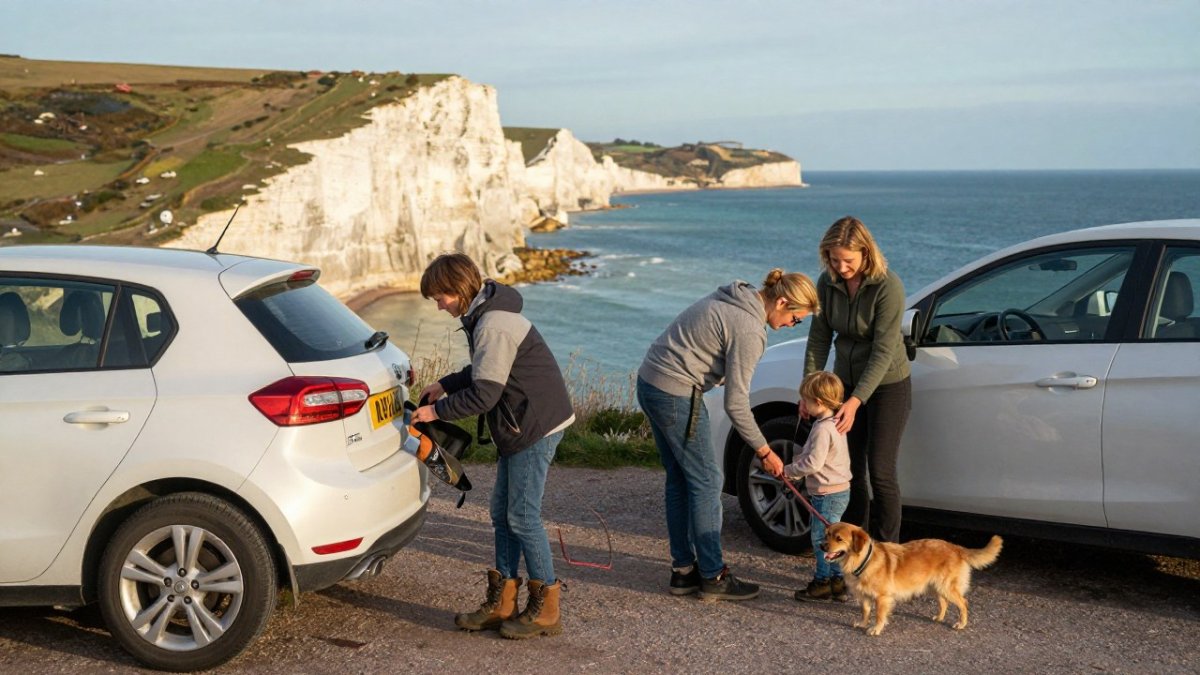
Day one: Bolberry to Hope Cove for a morning walk, then on to Salcombe for lunch and a charge, back via South Sands. Total driving is short, with long stops.
Day two: Bolberry to Bantham for the beach, then Thurlestone and a slow loop home through the lanes.
Tides, Steep Lanes and Seasonal Traffic
Check tide times before any beach stop, because several South Hams beaches change completely between tides.
Charging Overnight at Your Coastal Base
Overnight charging is a useful upgrade to any EV coastal break, as it sends you out each morning with a full battery and no planning needed.
Before you book anywhere, it's worth reading up on what to look for in EV-friendly accommodation. The key questions are simple: is the charger dedicated to your property, is the cable long enough to reach your parking space, and what happens if it's busy.
- Ask whether the charger is shared or private
- Confirm the connector type before arrival
- Check the parking is off-road and close to the charger
Spring Barn at Bolberry Court has an electric vehicle charging station on-site, so you can charge your car while you stay.
Book a South Devon Base With EV Charging On-Site
The best-planned electric trip still depends on where you sleep. A base with its own charger removes the hardest part of EV travel, which is the morning scramble to find a working point before the day starts.
Spring Barn at Bolberry Court sleeps up to 10, sits in the hamlet of Bolberry near Salcombe, and comes with a fully enclosed garden, underfloor heating and a log burner for cooler evenings. If you're still deciding how to fill your days, our guide to weekend getaway ideas for electric car owners in Devon pairs well with this one.
You can view our availability calendar to plan your dates, or take a closer look at Spring Barn and its setting before you decide.
The challenge with any EV break is confidence: knowing the car will be ready each morning and that the next charger isn't a gamble.
Frequently Asked Questions
How do I plan a coastal road trip in an electric car without running low on charge?
Start with your real-world range rather than the official figure, then subtract a safety buffer of around 15 to 20 percent for hills, weather and air conditioning. Identify rapid chargers roughly every 60 to 80 miles along your route and note a backup charger near each planned stop. Charge to 80 percent at rapid chargers because the last 20 percent takes far longer. Consider accommodation with on-site charging, such as Spring Barn at Bolberry Court, which has an electric vehicle charging station for guests.
How do I find electric car charging points in South Devon?
Use a route planner or charging app that shows live availability and connector type, then filter for rapid chargers near main routes such as the A38 and A379. South Devon's rural lanes have fewer chargers than cities, so check reviews for reliability and note the postcode of a backup site before you set off. Mobile coverage can be patchy in valleys, so download offline maps and save charger locations in advance.
Can I charge an electric car at my accommodation in South Devon?
Some self-catering properties now offer on-site charging, which removes the need to hunt for public chargers each evening. Spring Barn at Bolberry Court has an electric vehicle charging station for guests, so you can arrive after a long drive and top up overnight. Confirm the charger type and any access arrangements with the property before booking, and check whether you need to bring your own cable.
How should I plan charging stops on a long electric car journey with children?
Pair charging stops with meal breaks and leg-stretching time so the charge session does not feel like wasted minutes. Aim for stops of 20 to 30 minutes at rapid chargers, which is usually enough to add a useful amount of range. Plan stops near facilities such as toilets and cafes, and keep a backup charger in mind in case a unit is out of order. Booking a base with on-site charging reduces the number of public stops you need during your stay.
